Addsum web site and general info

Postings here will focus mainly on Advanced Accounting software updates, tips, and related topics. They will also include general comments relating to troubleshooting PC/Windows/network problems and may also include reference to our other software products and projects including any of our various utilities, or to the TAS Premier programming language. We considered setting up separate blogs for different topics so that users/others could subscribe to topics mostly aligned with their interests, but decided that it would be better to keep things simple since some topics cross over into others. We would nonetheless welcome your feedback/input in this regard. Our web site URL is www.addsuminc.com. Call us at 800-648-6258 or 801-277-9240. We also maintain www.advancedaccounting.us so that older Business Tools users in particular have a greater chance to find us. White list noreply@follow.it to ensure you receive notifications once you subscribe.

Monday, February 15, 2016

When Arial is missing

A long-time user contacted us today about migrating their Advanced Accounting 6.x system to a newer operating system on an also newly purchase computer.  They wondered whether the newer update that is available would fix a problem with both screen and printing having become excessively small and hard to read since making that change.

The "bitness" of the operating system of course had nothing to do with this issue; it was one we haven't seen before, but which many computer users have reported experiencing:  a missing Arial font installation.

The missing font of course also impacts the way that web sites are viewed in a browser.  For example, this is what our support page looked like from the end user PC:


This above is not what it normally looks like.

When the accounting software came up, the lower portion of the Advanced Accounting license screen appeared as follows:


Note the almost unreadable text starting with the Continue button and the rest of that screen.  Entry fields within the software were also very small and hard to read.

Because it is a standard font that is normally installed with all Windows installations, the most common font used in Advanced Accounting 6 and now 7i (and this will be true with the next release as well) is Arial (although it is not the only one).   When a font that is specified by an installed program is missing (including in web pages), the operating system attempts to find the closest available match, but the results can be unpredictable.

In checking installed fonts on this PC, there was no Arial.

After installing Microsoft's European Union Expansion Font Update which includes an updated version of Arial (along with Times New Roman, Trebuchet and Verdana), the problem was immediately solved, and without the need for a reboot.


Control Panel Fonts section after installation of MS font update (Windows 7 Pro)


Monday, January 18, 2016

More Advanced Accounting payroll updates

Some years are busier than others when it comes to payroll updates and features.   This year has been more hectic than usual.

Mainly this has been due to new features such as the new e-filing option (added towards the end of 2015 and for which testing was completed in early January of this year) and better support for reporting the cost of employer sponsored health plans (added in November of last year) rather than government mandated changes. 

To ease future updates, we have also made the calculation for the additional medicare tax open-ended into the future since it appears to be here to stay.  We've also added a new feature in the PR-F FUTA/SUTA history report to allow access to PR archives to include terminated employees in that particular option.  The PR-K option has been enhanced to allow for from/to wage bracket amounts in excess of $1,000,000 (necessary to fully and properly implement California tax tables, for example). The federal tables and the tables for California and several other states have also been updated.  Some states have posted no changes.

Oregon's complex existing logic has been updated to match January 1, 2016 required changes for that state (and our new e-filing capability is available to meet their paperless filing requirement for W-2's).  The internal required logic for Massachusetts has been updated including exemption amounts; standard exemption updates have also been made for Maine, Minnesota, New Mexico, New York, North Dakota and Vermont.  Users will also need to update PR-K state tax table changes in these and potentially other states.  Rhode Island's maximum wage limit has been updated but users will still need to update PR-K state tax code RIA (for example). More state changes will be made as they are identified.

Other programs providing for payroll capabilities often involve end user charges that on a monthly basis exceed the cost of an annual Advanced Accounting payroll update.  Our goal will be to continue to offer a feature-rich payroll module at a low cost of operation.    

More information 


Thursday, December 31, 2015

New federal-state e-filing payroll interface available for Advanced Accounting


A new federal and state e-filing interface has been added to Advanced Accounting 7i's payroll module that can be used to electronically file W-2 forms with both the IRS as well as in various states.

The trend towards paperless forms has been apparent for some time.  The threshold for filing state forms in many states continues to be lowered.  Some states (Connecticut, North Carolina, Oregon, Utah, and Virginia as of the date of this post) already do not accept the filing of paper W-2 forms, i.e. the threshold is zero. Minnesota has a threshold of just ten forms.   Six states have a requirement of either 25 or in one case 26, and another seven currently have a requirement of either 50 or 51.  These numbers will continue to drop, and states with state income tax withholding that currently have a high (or no) threshold will no doubt be implementing similar requirements in the near future.

While the IRS/SSA threshold is still 250, the IRS continues to strongly encourage e-filing to improve accuracy and timeliness and we would expect that number to be significantly lowered in the not too distant future.  States such as Utah have gone paperless under the philosophy that it is a safer mode of transmitting highly sensitive information.   Many end users are increasingly wanting to file their SSA copies electronically for this same reason.

Further, the complexity and ever-changing nature of these requirements both federally and on a state-to-state basis indicated that a better overall solution was needed for Advanced Accounting users.

A federal filing format option has long existed in the software and one that we have regularly updated over the years.  Originally it was referred to as the 'W-2 Electronic/Mag Media Filing" option.  We first started making significant updates to this option going back to at least as early as July of 1997.  That program was originally using the MMREF-1 format.  In tax years starting in 2007, the MMREF started to be referred to as the EFW2 format, which we continued to support through the end of 2014.

But the complications of that rather esoteric format coupled with increasing additions and requirements have made it difficult to make it a full solution even for federal-only e-filers. Further, states typically have their own separate requirements that the prior option could not satisfy.

So, in mid-December of 2014, we entered into some preliminary agreements with Nelco Solutions.  An actual interface however has not been available until now, and we are in the process of submitting test cases to validate the results (postscript: 2015 acceptance testing was completed on January 6, 2016).   We therefore anticipate that the interface will be available to users for 2015 filings, and it is being included in year end payroll updates.

Nelco specializes in W-2 and related e-filings and is an organization we have kept in touch with for well over a decade now in terms of potentially working together to come up with an effective solution for end users.   New capabilities and options will no doubt be made available to our payroll users and their employees as we go forward as a result of this collaboration.

Further, this option simply supplements the existing payroll module and in no way replaces it.

There are typically small fees associated with submitting these filings through the interface.  We believe that users will find these fees very reasonable particularly given not only the convenience and complexity involved but also in meeting applicable federal and state requirement. 

A quick overview of the new option and import process follows:


New PR-G option:


Answer "Y" to the export file option.  Then simply continue to process W-2's including a W-3 if desired.  This includes editing informational boxes as already provided in the software.   Prior to editing that information, however, when choosing the export file option, a new screen will appear asking for verification of the submitting company name, address, phone and e-mail.  In addition, you will be asked for the folder and file name of the export file. 


The file name can have any desired extension (a CSV extension is recommended).  If the directory does not exist, the program can optionally create it.   If the file name selected exists, you will receive a warning message and will be asked if you want to overwrite (normally you would not select an existing file).  

Click on proceed to continue and then proceed to process W-2's and optionally a W-3 as normal.  At the end of the normal process and after having chosen the export file option, you will then see a (new) launch portal screen from within the software.   This screen will also repeat the full path of the file name which we suggest you either copy and paste and/or make a handwritten note.  


Before clicking anywhere on the panel in the left corner of this screen, you can if desired retrieve the CSV in a spreadsheet program for review.  Normally you would not want to make any changes to the CSV file unless there is an unusual situation involving an error that needs to be corrected prior to submission.  The file otherwise must remain in the exact same format and delimited the same way.  The CSV file naturally contains confidential employee information which should be safeguarded and not made available to others.   We suggest retaining a copy of the file however at least until the process is completed and you receive acknowledgment of your filing request.   Submitting the file through the portal however is safe.

After launching the web portal (which you can also launch simply by copying and pasting the link provided under the clickable panel, and go to:

https://addsum.nelcoportal.com/import/gwximport


The PR-R-C option now also shows this same screen (but without the import file box) simply to provide a way to reference the portal's web site if follow-up or other action is needed, but not because the import is otherwise initiated here, as it formerly optionally was (this is is where the older EFW2 export option existed which has now been retired).

After launching the portal, either create a new account when logging in for the first time or log in with your previously established credentials. Then at the data import screen, import the same file that was created above within the accounting software (click on the Choose file option, and select the import file).


After clicking on import, unless problems were detected in the upload, you will select your filing options.  If you will only be filing federally, be sure to click on the "federal e-filing" check box.   


If wages are submitted for a state that has an e-filing option, a "State E-filing" check box option and an additional column next to each employee will appear. You can choose to file federal and state via the "a la carte services" section, or you can choose the "full" service (bundles) that also includes Nelco actually printing the employee copies and providing employees with e-mail address to the filings (requires the input of each employee's e-mail address; in a future Adv release we will be providing a more automated way to accomplish that).   So using the full/bundled service allows users to not even have to purchase W-2 forms and saves the time involved in both printing them as well as providing them to employees.

Make sure that the appropriate options are reflected on this screen.   Click on Next to review and submit your forms.


After clicking on Next from the submit forms, you simply enter your payment/card information and the process is complete.


More information:
Paperless Filing flyer (2015)

Additional operational and technical details:


If a problem is detected at the web portal import stage, those errors will be outlined as which point you can return to the import page to try again after correcting the errors (contact us 1-801-277-9240 or e-mail us at support@addsuminc.com to resolve any problems in this regard).

When filing in a given state, any required form that is required by that state will appear as part of the submission process with as many boxes already completed as possible based on the data imported.

(Postscript:  the information below about IE and Silverlight no longer applies starting in 2016)

While to initially submit and import data any of the major browsers seem to work without problems, Nelco recommends the use Internet Explorer.   When making state filings and a form has to be completed, the web portal may inform you that you need to use Internet Explorer with the free Silverlight plug-in.   This does not create any additional work should this happen since any imported data will still remain pending.  Switch to an IE browser with the Silverlight plug-in installed and log back into the portal and proceed to manage your account where you will be able to proceed with completing your submission.

In all it is an efficient and economic solution to federal and state e-filings.


Tuesday, December 15, 2015

Adapters and binders and provider order priority may cause chaos

Recently two of our accounting software users have reported problems that correspond to whether their PC's wireless Internet connectivity is enabled or not.   In one case, a Windows 7 Pro PC connected to Advanced Accounting across a network "stops working" when connected wirelessly for Internet access (normally the PC is without Internet access).  In another case (operating system unknown, probably Windows 7) , the software installed on the local drive and not networked operates as expected when the PC is wirelessly connected to the Internet, but the user experiences "run program not found" types of error messages when that connectivity is disabled.

Locally installed programs (on-premises software in today's jargon) usually do not care whether Internet connectivity is available or not, much less whether it is wired or wireless and that is certainly the case with Advanced Accounting.

Network adapter and binders priority and/or provider order settings that have been changed by other program installations may be responsible for these problems.

Microsoft has a tendency to to put wireless connections at a priority with newer PC operating systems.   Also certain programs may install themselves as having priority potentially creating  slowness.

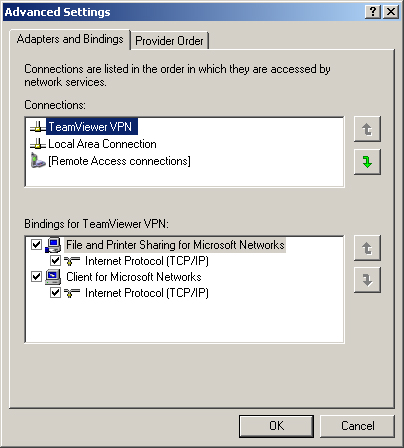
We note for example that the Teamviewer VPN likes to insert itself as first priority under Adapters and Settings.  This was a result of its installation and not because we placed it there:


TeamViewer VPN made itself first priority.  Even if we used it very often (we don't),
it would still be advisable to move Local Area Connection by highlighting it and then 

using the arrows at right to instead make it the first priority.

If you have wireless connections set before your local wired network, move your wired network above them.  Wired networks are always faster (and safer) and so if you have one, make it the priority.


Even Microsoft Terminal Services puts itself as the first network provider:
Move Microsoft Windows Network to the top by highlighting it and 
then using the arrow buttons at right.

Whether these changed priority settings would lead to local software not loading at all would be unexpected, however, it is known that bad or corrupt settings can lead to drive mapping failures including errors such as "Network path cannot be found."

Some examples:

http://www.tpateman.co.uk/reboot/unable-to-access-unc-paths-and-map-drives/

http://weblog.west-wind.com/posts/2013/Apr/04/UNC-Drive-Mapping-Failures-Network-name-cannot-be-found


To review and potentially change the order of Adapters and Bindings as well as your Provider Order, see below.


XP Pro:


On the desktop, right-click My Network Places, and then click Properties.

On the Advanced menu, click Advanced Settings.

On the Provider Order tab, in the Network Providers list, click Web Client Network.

Press DOWN ARROW so that Web Client Network is the last provider in the list, and then 
click OK.

Alternatively, you can change the network provider order in the registry. The registry 
entry is:

HKEY_LOCAL_MACHINE\SYSTEM\CurrentControlSet\Control\NetworkProvider\Order\ProviderOrder
The default value of this entry is RDPNP,LanmanWorkstation,WebClient.  

Above based on:
https://support.microsoft.com/en-us/kb/832161


Windows 7 including Win 2008 and 2008/R2:


See:

https://support.microsoft.com/en-us/kb/2526067

http://windows.microsoft.com/en-us/windows/change-network-protocol-bindings-order#1TC=windows-7

https://technet.microsoft.com/en-us/library/cc732472(v=ws.10).aspx


Windows 8/8.1:


www.laptopmag.com/articles/change-connection-priority-windows


Windows 10:

http://blogs.technet.com/b/networking/archive/2015/08/14/adjusting-the-network-protocol-bindings-in-windows-10.aspx


Make your local workstation and wired connections the first priority via these options, i.e. before  any wireless or other connections.  Occasionally re-check these settings.  If nothing else, your local network connectivity should be faster.

Thursday, November 12, 2015

W-2 reporting of employer-sponsored health coverage

Using Advanced Accounting's editable W-2 feature pertaining to boxes 10, 12, 13 or 14 first introduced in version 6 in 2007, the costs related to employer-sponsored health coverage can be easily input so that W-2 forms will contain this information as may be required.

While the requirement for this information went into effect in 2012, the IRS has provided transition relief for many businesses until "final guidance" is provided that still appears to be pending.  The current recommended course of action can be found hereIRS 2015 W2/W3 general instructions on the one hand indicate that reporting of these amounts is required, but then makes a somewhat circular reference to the Box 12 instructions which then refers one back to the recommended reporting guidelines and the reference to future guidance.

For those companies who either want to, or are required to, report the amounts, they are reported using code DD in Box 12 (a, b, c, or d). The amounts reported are not taxable to the recipient and are simply an information requirement (logically then Box 14 would have represented a more appropriate place for them, but that is not where they are reported). Unlike deferred compensation amounts included in Box 12 and carried over to box 12a on the W-3 form, code DD amounts are not reported on the W-3 transmittal form.

Previously anything entered in one of the four slots in Box 12 via Advanced Accounting's W-2 option were summed and included in the W-3 Box 12a total.  Starting in 2015, we have added programming logic to exclude any DD code amounts from being included in that total.   Other than this change (and adding some additional instructional language on the main screen of Advanced Accounting's PR-G option used to print W-2s as well as when presented with the "edit" question along with some screen changes to reference code DD on the pertinent input screen), the program remains the same.    

While we still support all versions of Advanced Accounting ever released, only the latest version (7i with latest updates, and soon version 8) will contain the changes described above.

So what are the steps for reporting this information?

(1) Give yourself enough time to tackle processing your W-2 forms even though it may not be particularly time consuming.  In this regard, take advantage of the "do it later" feature (i.e. under PR-G and then the option:   Clear employees/process W-2s later) which was first introduced in version 7i in early 2012;

(2)  Before proceeding to process your W-2 forms, accumulate information you may either be required to report, or that you may want to report, in the editable boxes.    Read through the latest W-2/W-3 instructions from the IRS and/or the instructions on the back of the W-2 forms paying particular attention to the editable boxes.  With respect to the cost of employer-sponsored health coverage, IRS instructions indicate that it should include both employer and employee paid amounts;

(3)  Nothing related to code DD is initially selected when tying employee deductions to IRS boxes, because the amount you might report under code DD will not likely correspond to those deductions.  Simply process as normal until you reach this question:


Answer:  Yes.

(4)  Next you will see a screen for each employee like this:


The highlighted Box 12 section is where you input the code DD and then to the right of that code, the cost amount for that employee.  It does not matter in which of the a,b,c, or d slots that you input the code and amount.  Further, you can input it in different places for different employees if you need to. (For simplicity however we would recommend using Box 12d for all DD amounts; or chose some other box that is the same for all; but again, this is not required.)  The program will include all amounts entered in Boxes 12 a,b,c, and d into the W-2 transmittal's Box 12a except it will now exclude any DD coded amounts.

(5) Simply continue to the next employee and process to completion as normal.


More information:
IRS Employer-Provided Health Coverage Informational Reporting Requirements: Questions and Answers

Sunday, November 1, 2015

XLS files: converting text to numbers


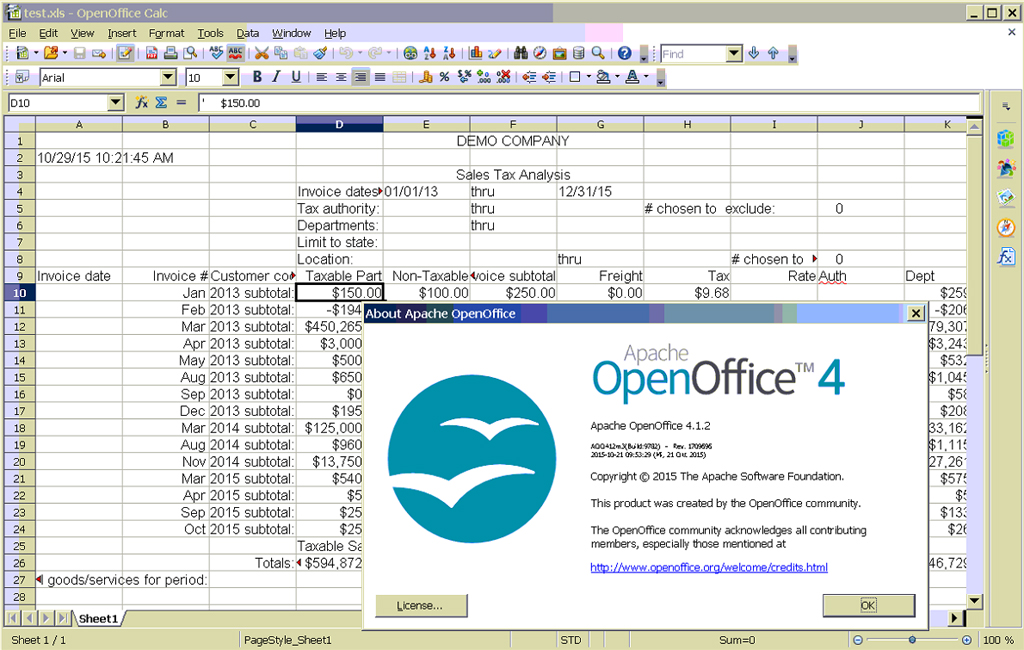
When retrieving an XLS file generated directly from the print to file option included in all Advanced Accounting versions from 6 through 7i (see printing to a file in Advanced Accounting) as well as upcoming release 8, numeric data may be initially formatted as "text" rather than as numbers.  In order to use the data in calculations, this text data can be easily converted from text to numbers via a few steps depending on the spreadsheet program that is used.  The discussion that follows outlines options available in OpenOffice Calc and Microsoft Excel to accomplish this task.

First, here's a preview of a sample report generated out of upcoming Advanced Accounting 8's enhanced sales tax analysis report grouping sales by month:


The discussion below involves retrieving the XLS file generated from this report and converting some of the columns to numbers.


OpenOffice Calc:

In OpenOffice, a leading apostrophe denotes text formatting.  


Rather then edit the cells individually, after retrieving the XLS file (click on File then Open and navigate to where the file was saved), first select and format all cells to numeric (not currency) with two decimal place precision.


Note:  a convenient way to select cells is to simply click on the first cell and then hold the SHIFT key and use down and ultimately right arrows.   Then click on Format then Cells to get the option above.

Without unselecting the cells, do a Find and Replace (click on Edit and then Find and Replace, or CTRL-F) .

Search for:

^. 

(i.e. input the caret or exponent symbol produced via Shift-6 followed by a period)


Replace with:

&

(i.e. an ampersand character, Shift-7)

Click on More options if the option list is not already expanded and make sure that "Regular expressions" is checked.

Click on Replace All, then Close.


All of the selected cells are now numeric.

The above procedure works in OpenOffice 2, 3 as well as the recently released 4.

Microsoft Excel:

There are many different versions of Excel, each of which may offer different approaches to accomplish this task.   A general reference document can be found here: How to convert text to numbers in Excel.

The "text to column" approach is one method (Method 7 in the link above), although it only works in selecting one column at a time and is not as convenient as in the OpenOffice Calc example.  Here is an example using Excel 2010 and this method.

Select one column of text that contains numbers.

Under the Data menu or tab, choose Text to Columns.

Choose Delimited, click on Next and choose Tab and again click on Next.


Choose General for the column data format.   Via the Advanced button, the decimal and separator options can be made, and then click Finish.   


Repeat for each column.


Wednesday, October 14, 2015

Panda antivirus: not our favorite


The truth is that we really do not have a favorite brand of antivirus protection software. Like death and taxes, antivirus software is not optional in today's world.   Often the antivirus and related malware detection applications however behave at a level equivalent to some viruses.  And they typically steal processing power along with their incessant updates making computer use much less enjoyable and efficient.

Users are further placed into the unsavory position of having to choose sometimes between antivirus packages that have excellent detection but high resource utilization versus antivirus software that has lower detection accuracy but also lower resource usage demands.  

Often Norton/Symantec Antivirus and McAfee brands have been the causes of PC slowness. Over the years, however, we have heard of more rogue problems with Panda Antivirus than any other.  And today was no exception.

Yesterday we updated an end user's main executable with a newer version simply as a part of an update and because it might have helped with an issue they were having.   Everything was working fine until an automatic update occurred on that system this morning. The update at least in part involved Microsoft updates (this was on a Windows 7 Ultimate operating system). The 19 Microsoft updates that were installed rendered the PC unusable for a time, a story that is all to common (and we recommend managing these on a non-automatic basis for exactly this reason). The end user though was also using Panda Antivirus 2015, and we suspect that a Panda update also occurred. After these updates and after having used the executable associated with the software earlier today that we had updated yesterday, the executable simply vanished along with the desktop icon associated with it.

And it was Panda Antivirus 2015 that removed it.  When adding it back, naturally Panda still refused to allow access. Initial responses however were Windows permission and networking errors and nothing from Panda until finally:


What was suspicious about the file?  Because it was downloaded via a web service (in this case via file transfer protocol)?  Yet that's where pretty much everything comes from these days.   No other details whatsoever?  No indication of the publisher name or the digital signature date if that information is present (which it was) so that the user can make an informed decision?  How would the user otherwise easily, quickly and without having a somewhat high level of expertise know what to do?  How high of a burden is this to place on a end user without providing as much information as possible in a case involving a false positive as here?   Won't this then encourage the user without this information to "neutralize" (a euphemism for delete, kill, remove, etc.) the threat?   The "threat" once averted then cripples the end user system.

So at this point, the file can be "excluded" and the software was then again operational, but that alone is not enough.  Exclusions need to be added as we did here after this problem arose:


(Any antivirus program you use should allow for adding exclusions or exceptions.  If it doesn't, find another antivirus program.)

Prior to adding the exclusions above, Panda's settings reflected the fact that the files had been quarantined but then excluded.


And this is not the first time we have seen this happen.   A different system in 2013 that was using Panda and a software package that also uses the same executable suddenly experienced the same thing and that was on system that had not changed for some period of time. Yet, these are are simply completely valid, digitally signed executables with no compression and which have been widely used on many other systems and not falsely detected as being suspicious by other antivirus software.

Is it possible that users when presented with the "suspicious file" option are choosing "Neutralize" rather than "Exclude" since it is the first option and since it sounds less benign, and so the removal is actually being confirmed by the user?  Yes, that is possible, and we can't be certain that did not happen in these two cases, but there have been other reports of files deleted by Panda that did not appear to involve any user interaction.

In much older systems (and going back into the late 90's) we had several reports from users using Panda where false positives would occur on end user data files (and so not executable files at all) that could not possibly be infected with a virus, and yet in at least two cases Panda actually deleted the end user's data (files that just happened to not be open that Panda decided to quarantine and delete them) during daily operation of the software.  

We've never experienced these problems with any other commercial antivirus software programs.

This points out how critical it is to exclude critical software installations such as accounting software or heavily used production systems from real-time antivirus or malware scans.   False positives can and do happen with all antivirus software.   And if you use Panda, you are at even greater risk if you do not do this.

And also be very wary when updates occur.  While Panda is not alone in having update problems, earlier this year a significant problem arose with a Panda update, see this story published on March 11, 2015 in the iDigitalTimes:  Panda AntiVirus Update Problems Bricked Your Computer? Here's How To Fix Wiped Files And Restore Your PC Stability.

Is the cure worse than the disease?  Maybe not, but often it seems that way.